Checking three-phase high voltage (380 - 415 V) customer power and main line power
cables
Before you begin
Restriction: You must not reuse existing Model 941, 94E, 951, 95E or prior model main
line power cables or customer connections. They can permanently damage the DC-UPS power supplies.
About this task
The DC-UPS requires a five-wire power connection that includes a neutral wire. (One neutral
wire, three voltage phase wires, one ground wire.)
The Model 941, 94E, 951, 95E and prior models use a four-wire connection that does not use a
neutral wire.
Procedure
In the sections that follow, you must:
Ensure the customer will provide a five-wire (with neutral) main line power cable
connection.
Use only the main line power cables that are provided. These main line power cables have the
color power type label on the DC-UPS connector.
Ensure the mainline power cable connector neutral pin at the
DC-UPS end is properly wired. Repeat this step for each mainline power cable being installed.
Prepare the multimeter to measure 0.1 ohm or less resistance.
Place one lead of the multimeter on the mainline power cable connector neutral pin at
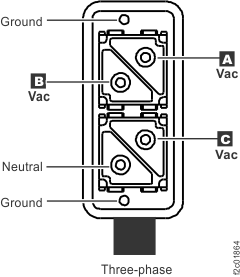
the DC-UPS end of the cable. Refer to Figure 1.
If the customer end of the mainline power cable has bare wires, place the other lead
of the multimeter on the blue wire.
The following lists the mainline power cable wire color codes ("wired" configurations):
Vac (phase 1) = brown
Vac (phase 2) = black
Vac (phase 3) = gray
Neutral = blue
PE (ground) = green/yellow
If the customer end of the mainline power cable has a
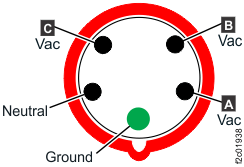
five-pin connector, place the other lead of the multimeter on the neutral pin. Refer to Figure 2.
Is there more than 0.1 ohm of resistance?
Yes, stop the installation. Do not continue until the power cable check is successful.
No, continue with the next step.
Figure 1. Three-phase high voltage (380 - 415 V) mainline power connector at DC-UPS end
Figure 2. Three-phase high voltage (380 - 415 V) 30A, IEC60309 cable connector pins