Exchange the Enclosure Services Manager (ESM)

Before you begin

Icon for electrostatic discharge wrist strapUse approved ESD procedures to prevent damage.

Attention:
  • This procedure is not a stand-alone procedure. Customer disruption and damage to the hardware might occur when microcode and power boundaries are not in the proper conditions for this service action.
  • If a serviceable event FRU repair directed you to this procedure, the microcode and power boundaries are already set.
  • If a serviceable event FRU repair did not direct you to this procedure, see MAP1230 Replace a FRU without using a serviceable event.
Notes:
  • All the cables and FRUs to be removed must be uniquely identified so they can be reinstalled correctly.
  • If an installed earthquake resistance kit prevents you from accessing this FRU, refer to MAP1600.

Remove the ESM

Procedure

  1. To locate this FRU, do one of the following and then return here and continue to replace the FRU:
    • If this FRU has a FRU identify indicator, use the FRU identify indicator, which is listed in MAP1240 Locating FRUs by using identify indicators. If not, use the location code.
      Note: There might be cases where the FRU failure or fencing conditions prevent the FRU LED indicator from being lit even if the FRU has power.
    • Use the location code, which is listed in MAP1245 Finding FRUs by using location codes.
    • If there is no FRU identify indicator or location code, you were sent here by an isolation MAP or symbolic FRU procedure. Use the information in that procedure and the figures in this procedure to locate the proper part to exchange.
  2. Most, but not all, FRUs have identify indicators. Use the flashing amber or solid blue FRU identify indicators to ensure that you are working on the correct enclosure, FRU, or both.
  3. If microbays are located behind the affected storage enclosure, move one or both microbays to the service position as needed to allow access to the storage enclosure.
    Note: Do not disconnect any microbay cables.
    1. Press the release tabs Callout label 1 toward the center of the microbay. See Figure 1.
    2. Slide the microbay back to the service position. See Figure 1.
    Figure 1. Microbays C1 (left, in operating position) and C2 (right, in service position)
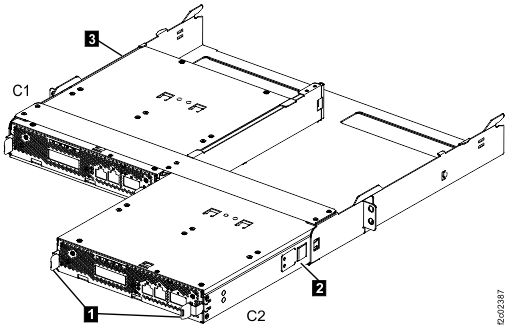
    Microbays C1 (left, in operating position) and C2 (right, in service position)
  4. At the rear of the rack, ensure that the SAS cables connected to Cx-T1 and Cx-T2 are properly labeled and disconnect them from the ESM being removed. See Figure 2.
    Figure 2. Storage enclosure locations (rear view) (SAS flash enclosure, 24 drive slots)
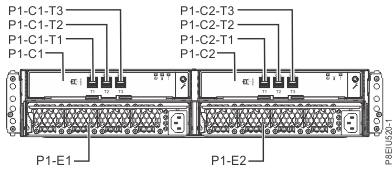
    Storage enclosure locations (rear view) (SAS flash enclosure, 24 drive slots)
  5. Open the two release levers Callout label A as shown in Figure 3.
  6. Support both sides of the ESM while you slide it out of the enclosure.
    Note: After the card is unplugged, storage enclosure fans might shift from low to high speed. This shift in speed is normal behavior.
    Figure 3. Removing an ESM from the drive enclosure
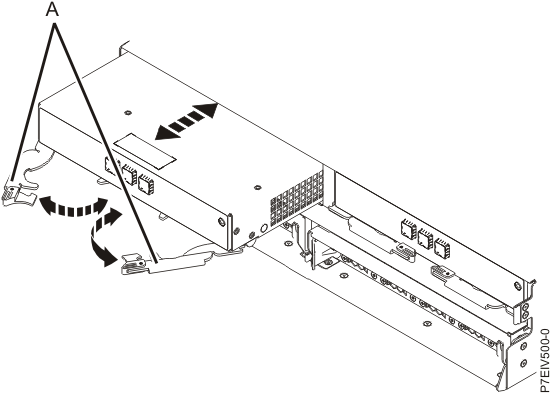
    Removing an ESM from the drive enclosure

Install the ESM

Procedure

  1. Move the dust cover (if present) from the old ESM to the new ESM.
  2. With the levers in the open position (away from each other), slide the new ESM into its slot.
  3. Push the levers toward each other to fully seat the ESM in its slot. Ensure that the levers are fully closed.
    Note: After the ESM is fully seated, several LEDs might go on and off as the ESM goes through its initialization sequence. Also, storage enclosure fans might change speeds. This behavior is normal.
  4. Connect the SAS cables to correct ports. See Figure 2.
  5. If any microbays are in the service position, return them to the operating position.
    1. Slide the microbay forward to the operating position.
    2. Ensure that the release tabs latch into the microbay tray. See Figure 1.
  6. Exit this service information center parts exchange procedure and return to the procedure that sent you here.