This procedure is not a stand-alone procedure. Customer disruption and damage to the hardware
might occur when microcode and power boundaries are not in the proper conditions for this service
action.
If a serviceable event FRU repair directed you to this procedure, the microcode and power
boundaries are already set.
All the cables and FRUs to be removed must be uniquely
identified so they can be reinstalled correctly.
If an installed earthquake resistance kit prevents you from accessing this FRU,
refer to MAP1600.
About this task
Determine rack version
Procedure
Determine the rack version.
At the rear of Rack-1, observe the location of the Rack
identity and Local remote switch cards. See Figure 1.
Version 1, the cards are vertical and mounted to the
left sidewall, go to Section-1 Rack Version 1.
Version 2, the cards are horizontal and mounted to the
top of the rack, go to Section-2 Rack Version 2.
Figure 1. Identifying rack version 1 versus version 2
Section-1 Rack Version 1
Remove the local remote switch card (rack version 1)
About this task
Note: This procedure is for the Local Remote Switch Card
and the zSeries Local Remote Switch Card. The zSeries Local Remote
Switch Card has four additional connectors above the
Local/Remote switch that can connect up to four customer remote power
control cables.
Procedure
To locate this FRU, take one of the following actions and then return here and
continue to replace the FRU:
If there is no FRU identify indicator or location code, you
were sent here by an isolation MAP or symbolic FRU procedure. Use the information in that procedure
and the figures in this procedure to locate the proper part to exchange.
Most, but not all, FRUs have identify indicators. Use the flashing amber or solid blue FRU identify indicators to ensure that you are working
on the correct enclosure or FRU.
The light path identify LEDs are a hierarchy of LEDs that can
identify the rack, enclosure, FRU, and even the FRU connector to which a cable is
connected.
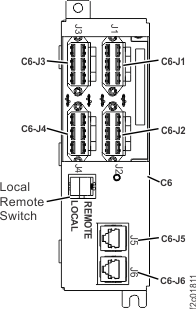
At the top left rear of the rack, put the local
remote switch card Local/Remote switch to the Local position (left).
See Figure 2.
Attention: The switch must be placed in the Local position for
this repair.
Figure 2. Location codes for the zSeries local
remote switch card (local remote switch card does not have J1, J2,
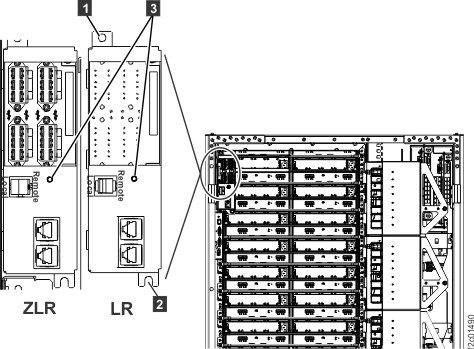
J3, J4)Figure 3. Local remote card screw locations
Disconnect the RPC cables from the switch card
connectors J5 and J6.
For the zSeries local remote switch card, disconnect
the remote power control cables (if any) from switch card connectors
J1, J2, J3, and J4.
Remove screw and loosen screw .
Slide the card up and then remove it.
Install the local remote switch card (rack version 1)
Procedure
Ensure the Local/Remote switch on the card being installed
is in the Local position (left).
Gently slide the card under the screw , install screw , and tighten both.
For the zSeries local remote switch
card, connect the remote power control cables (if any) to switch card
connectors J1, J2, J3, and J4.
Connect the RPC cables to the switch
card connectors J5 and J6. Ensure that the cables are not cross-connected.
The FRU verification tests for this FRU cannot
detect disconnected or cross-connected cables. Use the location code
label on each cable to ensure that it is properly connected.
Observe the local/remote switch card amber identify LED . See Figure 3.
No. The signal to blink the ID LED comes from both RPC cards.
Ensure you properly connected the cables in step 4. If they are properly
connected, call the next level of support or replace the local/remote
switch card again.
Put the Local/Remote switch to the Remote
position (right).
Exit this service information center parts
exchange procedure and return to the procedure that sent you here.
Section-2 Rack Version
2
Remove the local remote switch card (rack version 2)
About this task
Note: This procedure is for the Local Remote Switch Card
and the zSeries Local Remote Switch Card. The zSeries Local Remote
Switch Card has four additional connectors to the left of the Local/Remote
switch that can connect up to four customer remote power control cables.
Procedure
To locate this FRU, take one of the following actions and then return here and
continue to replace the FRU:
If there is no FRU identify indicator or location code, you
were sent here by an isolation MAP or symbolic FRU procedure. Use the information in that procedure
and the figures in this procedure to locate the proper part to exchange.
Most, but not all, FRUs have identify indicators. Use the flashing amber or solid blue FRU identify indicators to ensure that you are working
on the correct enclosure or FRU.
The light path identify LEDs are a hierarchy of LEDs that can
identify the rack, enclosure, FRU, and even the FRU connector to which a cable is
connected.
At the top middle rear of the rack, put the local
remote switch card Local/Remote switch to the Local position (push it away
from you). See Figure 4 and Figure 5.
Attention: The switch must be placed in the Local position for
this repair.
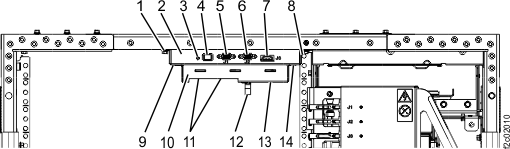
Figure 4. Location codes for the zSeries local
remote switch card (local remote switch card does not have J1, J2,
J3, J4)Figure 5. Local remote switch card
Disconnect the RPC cables from the switch card connectors J5
and J6.
For the zSeries local remote switch card, disconnect
the remote power control cables (if any) from switch card connectors
J1, J2, J3, and J4.
Loosen screw and slide the card to the left and
down to remove it. The card tab releases from the slot .
Install the local remote switch card (rack version 2)
Procedure
Ensure the Local/Remote switch on the card being installed
is in the Local position (left).
Slide the card tab into the slot while lifting the keyhole slot up
over the screw . Gently slide the card to the right
and then tighten the screw.
For the zSeries local remote switch
card, connect the remote power control cables (if any) to switch card
connectors J1, J2, J3, and J4.
Connect the RPC cables to the switch
card connectors J5 and J6. Ensure that the cables are not cross-connected.
The FRU verification tests for this FRU cannot
detect disconnected or cross-connected cables. Use the location code
label on each cable to ensure that it is properly connected.
Observe the local/remote switch card amber identify LED . See Figure 3.
No. The signal to blink the ID LED comes from both RPC cards.
Ensure you properly connected the cables in step 4. If they are properly
connected, call the next level of support or replace the local/remote
switch card again.
Put the Local/Remote switch to the Remote
position (pull it towards you).
Exit this service information center parts
exchange procedure and return to the procedure that sent you here.
 Use approved ESD procedures to prevent damage.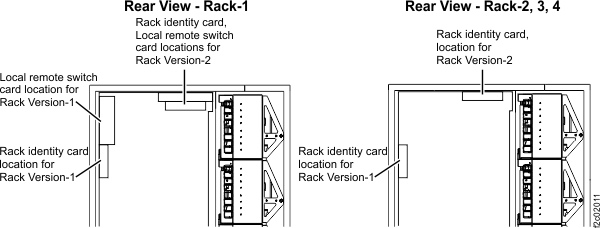
 and loosen screw
  .
. . See Figure 3.
  Local/Remote switch
  to the Local position (push it away
from you). See Figure 4 and Figure 5.
Attention: The switch must be placed in the Local position for this repair.
to the Local position (push it away
from you). See Figure 4 and Figure 5.
Attention: The switch must be placed in the Local position for this repair.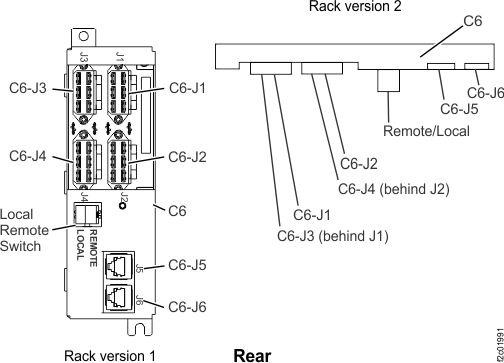
 from the switch card connectors J5
and J6.
from the switch card connectors J5
and J6.  (if any) from switch card connectors
J1, J2, J3, and J4.
(if any) from switch card connectors
J1, J2, J3, and J4. .
.