Exchange the bus bar, 208VDC primary
Before you begin
 Use approved ESD procedures to prevent damage.
Attention:
- This procedure is not a stand-alone procedure. Customer disruption and damage to the hardware might occur when microcode and power boundaries are not in the proper conditions for this service action.
- If a serviceable event FRU repair directed you to this procedure, the microcode and power boundaries are already set.
- If a serviceable event FRU repair did not direct you to this procedure, see MAP1230 Replace a FRU without using a serviceable event.
Notes:
- All the cables and FRUs to be removed must be uniquely identified so they can be reinstalled correctly.
- If an installed earthquake resistance kit prevents you from accessing this FRU, refer to MAP1600.
Remove Bus bar 208VDC primary
Procedure
- If this is an expansion rack and it has old level sheet metal, the sheet metal
baffle
 to the left of the gate and at the bottom of the storage enclosure chassis might need to be
removed to allow the gate to swing open. Remove the two screws that fasten the baffle to the 19" rack mount vertical rails. If the baffle is the new level
sheet metal, it has a flexible plastic cutout that bends out of the way when the gate is swung
open.
to the left of the gate and at the bottom of the storage enclosure chassis might need to be
removed to allow the gate to swing open. Remove the two screws that fasten the baffle to the 19" rack mount vertical rails. If the baffle is the new level
sheet metal, it has a flexible plastic cutout that bends out of the way when the gate is swung
open.
Figure 1. Air baffle 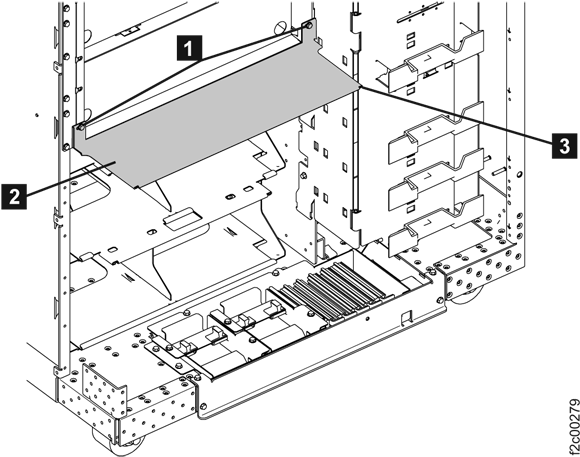
- Remove the two screws
 and open the 208VDC bus bar gate to the service position.
 Figure 2. 208VDC bus bar gate service position 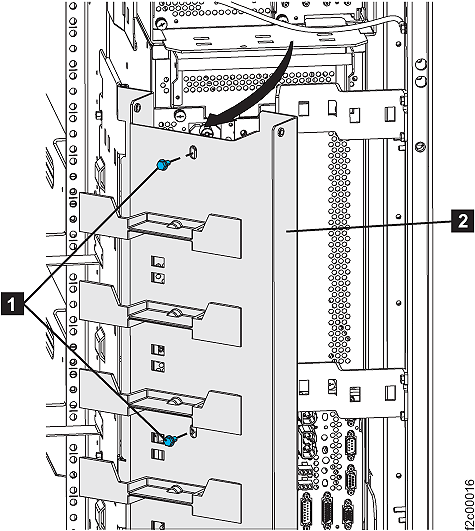
- Determine the PPS supplying
208VDC to the bus bar being replaced.
- The bus bar nearest the rear of the rack is connected to PPS-1 (upper PPS). Verify
this by tracing the two black power cables
 .
. - The bus bar nearest the front of the rack is connected to PPS-2 (lower PPS). Verify
this by tracing the two black power cables between the PPS and bus
bar.
Figure 3. 208VDC primary bus bar cables 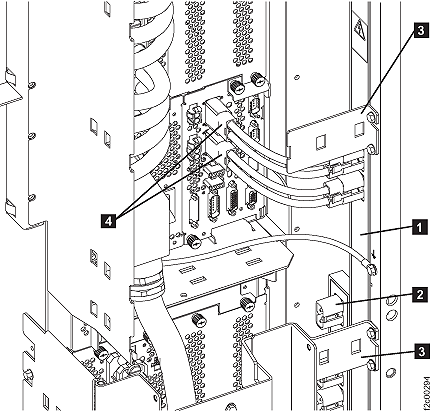
- The bus bar nearest the rear of the rack
- Switch the PPS input
module CB00 switch to Off (down).
Figure 4. Power supply main line CB00 switch 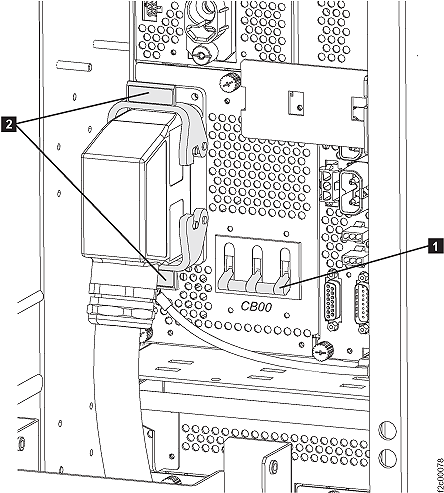
- Remove any rack cable brackets
 (see Figure 3) and ground wires as
needed to have clearance to remove the bus bar.
(see Figure 3) and ground wires as
needed to have clearance to remove the bus bar.
Install Bus bar 208VDC primary
Procedure
- Place the new bus bar in the rack and install the retention nuts.
- Reinstall any rack cable brackets and ground wires that were removed.
- Connect the black power cords to the proper bus bar connectors.
- Swing the bus bar gate back into the closed position and reinstall the two retention screws.
- Switch the PPS input module CB00 switch to On (up).
- Exit this service information center parts exchange procedure and return to the procedure that sent you here.